EFFECT OF REMOTE WORK ON MENTAL HEALTH, 2021

Project links
Skills
About this project
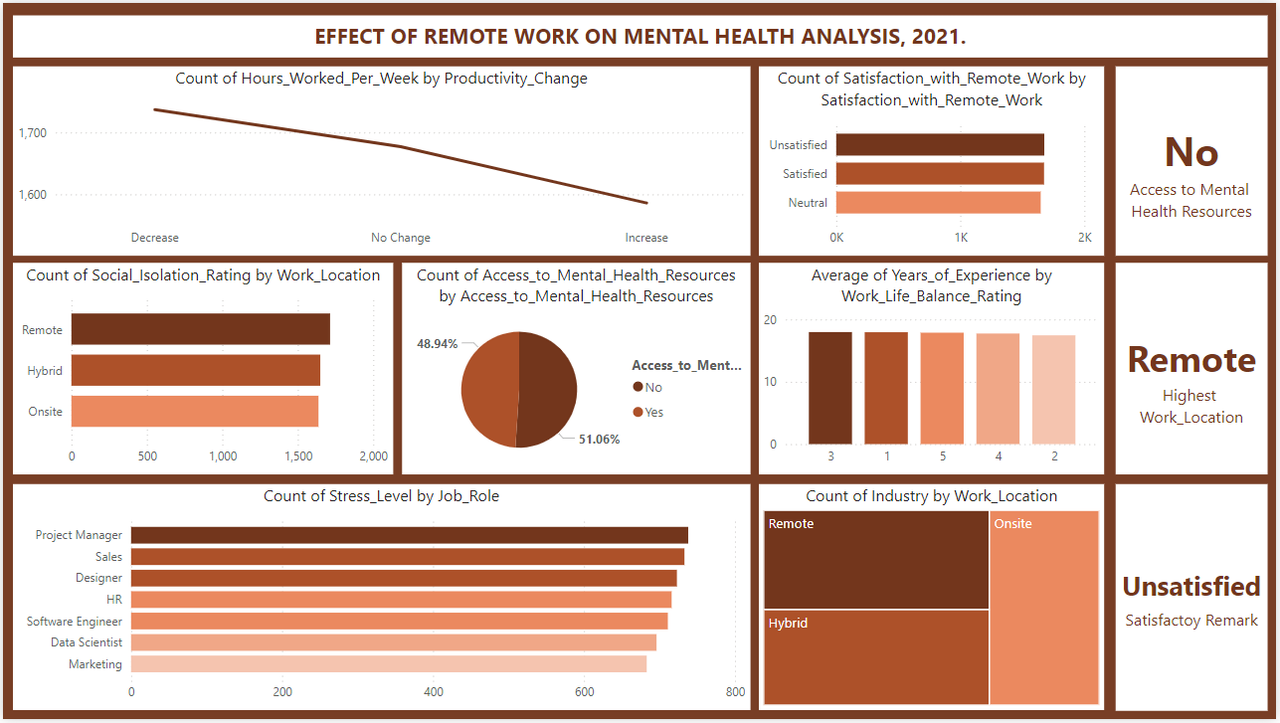
while remote work offers flexibility and eliminates long and tiring commutes, it has lots of challenges that can sometimes be overwhleming and eventually degrades the mental health of indiviual workers or staff. Below are some of the observations drawn from the analysis
Remote workers reported high counts of social isolation (1714) when compared to hybrid or onsite workers.
The onsite workers showed the lowest count of social isolation which directly portrays the fact that thye have more balanced social engagement as thye are often out and interacting with others.
The majority of employees (1737) experienced a decrease in productivity when working longer hours per week. Those with no productivity change (1677) follow closely after while 1586 employees reported increase in [productivity due to shorter working hours per week.
A larger number of these workers do not have access to mental health resources which could also be directly linked to poor or degenerating mental health for individuals
The satisfaction with remote work when compared with the other types of work location does not make a huge differece from the analysis and these may outrightly depend on job roles per industry
Industries solely reliant on remote workers report higher stress levels and lower satisfaction as observed from th chart analysis.
However, following the observations enumerated above, the following recommendtions have been made and they include;
- Encourage flexible work schedules that allows employees to manage persoanl and professional commitments effectively and also do a regualr feedback exercise that helps the management identify challenges these workers face and address them immediately to encourage and incresse productivity in the long run.
- A very crucial necessity to work on would be to offer good subsidized health support programs such as workshops, counselling, therapy sessions, etc such that everyone could afford them whenever the need arises regardless of their pay checks.
- it will be paramount to manage work hours so as to increase efficiency and productivity by offering or promoting trainings in time management to help employees maintain balance without overworking themselves.
- Encourage breaks at work.
- As a way to combat the issue of social isolation, the industries involved could facilitate team bonding events to bring workers together and increase thir social networking and keeping their minds off work at the time.